
Lampang
ลำปาง · Lampang Province
Population
58K
Budget / Month
$290
Internet
55 Mbps
Best Season
November to February (cool season)
About Lampang
Lampang is a mid-sized northern Thai city sitting in a broad river valley along the Wang River, roughly 100 kilometers southeast of Chiang Mai. It is the second-largest city in northern Thailand, yet it receives a tiny fraction of the tourists who flock to its famous neighbor. This anonymity is Lampang's greatest charm — it offers authentic Lanna culture, stunning temples, and a genuinely local atmosphere at prices even lower than already-cheap Chiang Mai.
Lampang's history is deeply intertwined with the Lanna Kingdom, which controlled northern Thailand from the 13th to 18th centuries, and later with the Burmese, who occupied the region for over 200 years. This dual heritage is visible in the city's extraordinary temples. Wat Phra That Lampang Luang, just outside the city, is one of the most important and well-preserved Lanna temples in all of Thailand — a walled compound with a massive open-sided viharn, ancient murals, and a rare camera-obscura effect that projects an inverted image of the chedi onto the wall of a small chapel. Inside the city, Wat Phra Kaew Don Tao once housed the Emerald Buddha (now in Bangkok) and features a stunning Burmese-style mondop. Several other temples display the distinctive multi-tiered Burmese roof style brought by teak traders from Myanmar.
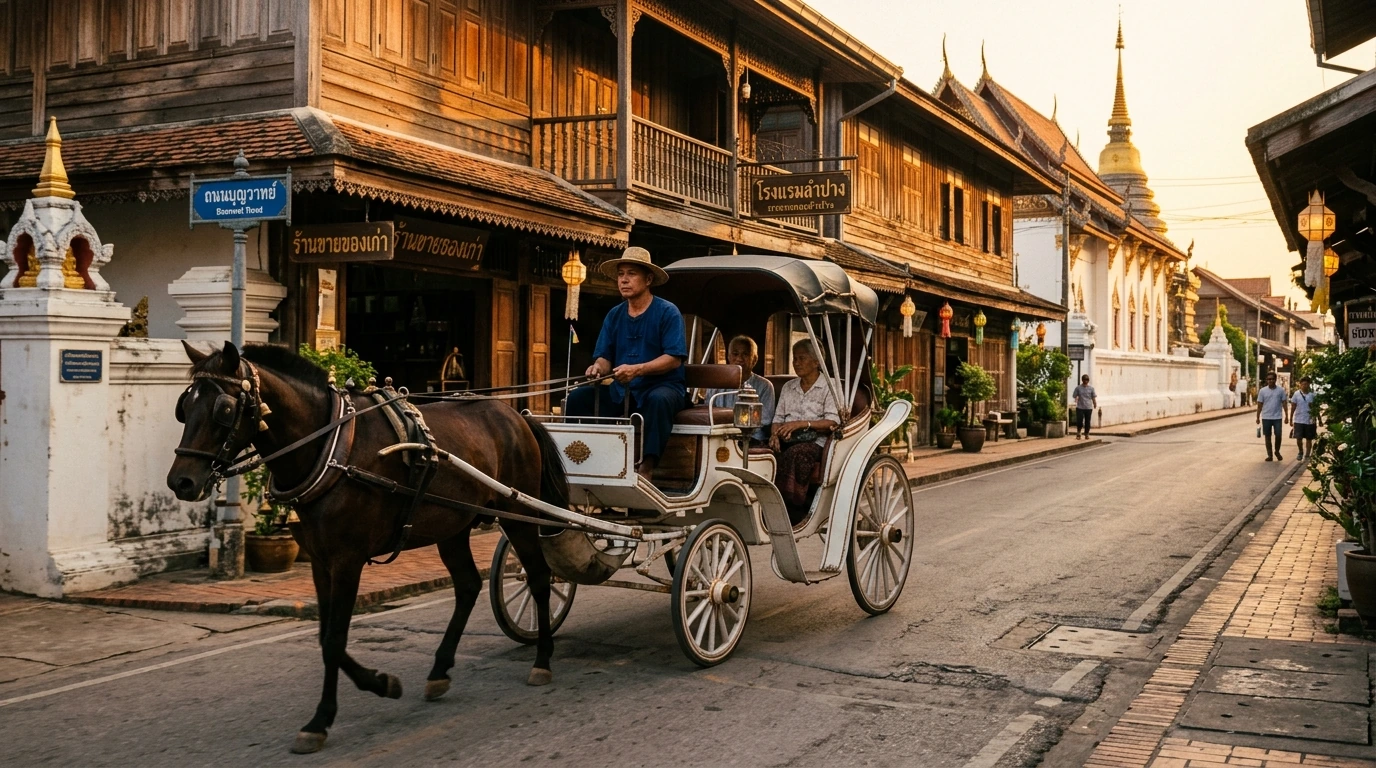
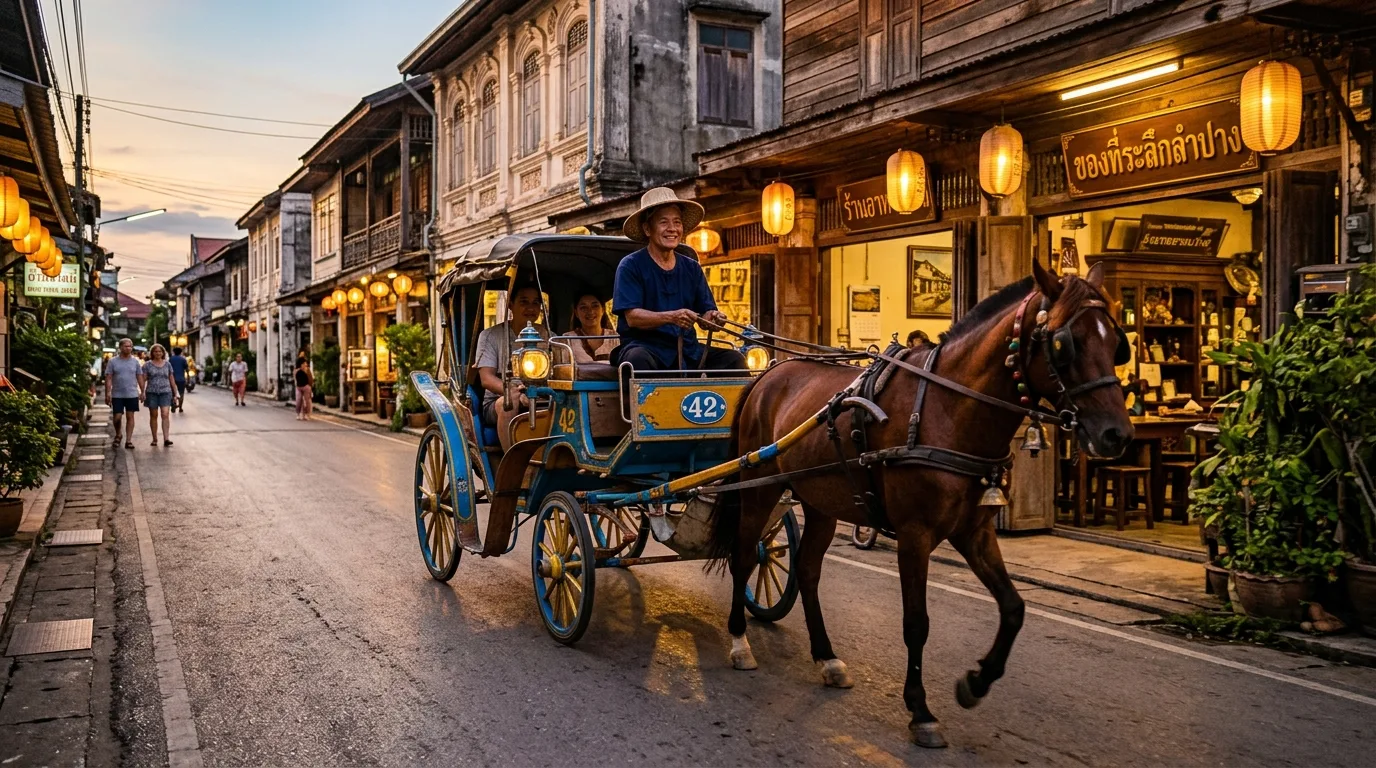
The horse-drawn carriage is Lampang's signature. The city is the last place in Thailand where horse carriages are used for daily transportation, not just tourism. The clip-clop of hooves on the old town streets gives Lampang a uniquely nostalgic atmosphere. Weekend walking streets along the Wang River (Kad Kong Ta) transform the old shophouse district into a lively market with local food, Lanna music, and handicrafts.
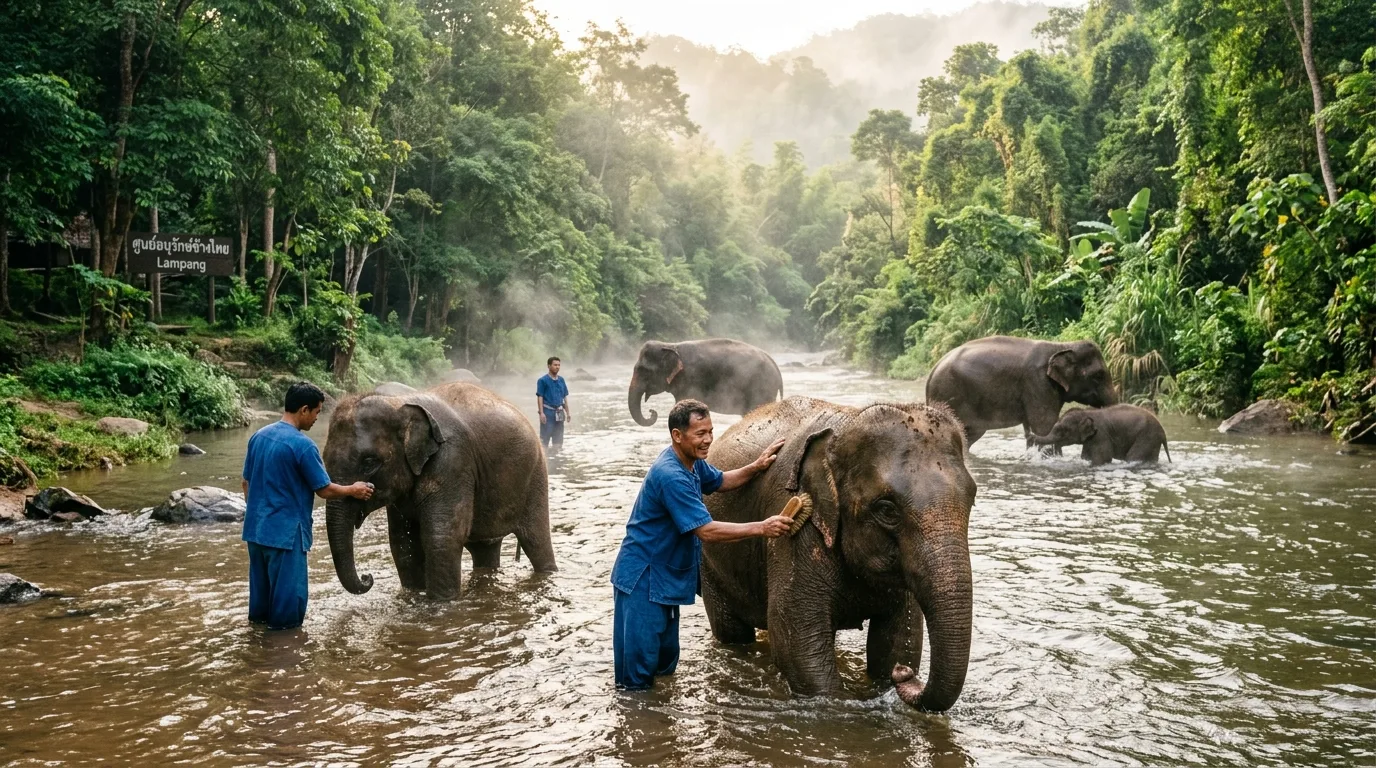
Lampang is famous across Thailand for two things: ceramics and elephants. The Lampang chicken bowl — a white ceramic bowl with a hand-painted rooster — is an iconic Thai household item, and the Dhanabadee Ceramic Museum tells the story of the industry. The Thai Elephant Conservation Center, located 30 kilometers from the city, is Thailand's premier ethical elephant facility where visitors can bathe, feed, and interact with elephants in a responsible setting.
The city appeals to slow travelers, culture enthusiasts, temple lovers, and anyone who wants the northern Thai experience without tourist infrastructure. Daily life revolves around morning markets, coffee shops, and temple visits. The cafe scene is surprisingly good, reflecting northern Thailand's coffee-growing culture. Lampang is extremely affordable — cheaper than Chiang Mai for both accommodation and food. The internet is adequate but not exceptional, making it more suitable for light remote work or travelers than serious digital nomads. Like other northern cities, Lampang suffers from severe smoke haze during burning season (February to April), when agricultural fires fill the valley with hazardous air pollution. The cool season from November to February is the ideal time to visit, with crisp mornings, clear skies, and comfortable temperatures.
Historical Note
Lampang was an important city in the Lanna Kingdom and was later occupied by the Burmese for over 200 years, leaving a distinctive architectural heritage visible in its many Burmese-style temples. The city became a center of the teak trade in the 19th century, attracting Burmese and Shan teak merchants whose descendants still live here. Wat Phra Kaew Don Tao once housed the Emerald Buddha, now Thailand's most sacred Buddhist artifact in Bangkok.
Best time to visit: November to February (cool season)
At a Glance
Thai Name
ลำปาง
Province
Lampang
Region
Northern
Population
58,442
Area
22.2 km²
Elevation
268 m
Postal Code
52000
Airport
LPT
Local Language
Northern Thai (Kam Muang), Central Thai
Cost of Living
budget
/month10,200 THB
~$290 USD
comfortable
/month18,700 THB
~$535 USD
luxury
/month37,500 THB
~$1,070 USD
accommodation
| Item | Low (THB) | High (THB) |
|---|---|---|
| Hostel/guesthouse dorm | 150 | 250 |
| Budget hotel/guesthouse | 250 | 500 |
| Mid-range hotel | 500 | 1,200 |
| Boutique hotel | 1,200 | 3,000 |
| Monthly rent (room/studio) | 2,500 | 4,000 |
| Monthly rent (1BR apartment) | 3,500 | 6,000 |
food
| Item | Low (THB) | High (THB) |
|---|---|---|
| Street food meal | 30 | 50 |
| Local restaurant meal | 40 | 80 |
| Night market / walking street meal | 30 | 60 |
| Coffee (specialty cafe) | 40 | 80 |
| Beer (local, bottle) | 45 | 70 |
| Water (1.5L) | 8 | 14 |
transport
| Item | Low (THB) | High (THB) |
|---|---|---|
| Horse-drawn carriage ride | 200 | 300 |
| Songthaew (in town) | 10 | 20 |
| Motorbike rental (day) | 150 | 250 |
| Motorbike rental (monthly) | 2,000 | 3,000 |
| Bicycle rental (day) | 50 | 100 |
| Train to Bangkok | 200 | 1,300 |
utilities
| Item | Low (THB) | High (THB) |
|---|---|---|
| Electricity (monthly) | 300 | 800 |
| Mobile data (30-day SIM) | 299 | 599 |
| Home internet (monthly) | 399 | 699 |
| Laundry (per kg) | 25 | 40 |
entertainment
| Item | Low (THB) | High (THB) |
|---|---|---|
| Thai massage (1 hour) | 150 | 200 |
| Elephant Conservation Center entry | 200 | 200 |
| Ceramic painting workshop | 100 | 300 |
Internet & Connectivity
Speed Test Averages
vs Bangkok Average (200 Mbps)
28% of Bangkok speed
Providers
Coworking Spaces
0
Weather & Climate
November to February for cool weather (13-30C) and clear skies. March to May is hot and smoky (burning season). June to October is rainy but green and atmospheric.
Burning Season Warning
Lampang experiences severe burning season from February through April. Agricultural fires and forest burning in the surrounding valleys create thick smoke haze with AQI frequently exceeding 200. The mountains disappear, outdoor activities become uncomfortable, and people with respiratory issues should avoid the city during this period. Air quality is typically worst in March.
| Month | High °C | Low °C | Rain (mm) | Humidity |
|---|---|---|---|---|
| Jan | 30 | 13 | 5 | 58% |
| Feb | 33 | 15 | 5 | 50% |
| Mar | 36 | 19 | 15 | 47% |
| Apr | 37 | 23 | 45 | 55% |
| May | 34 | 23 | 145 | 72% |
| Jun | 33 | 23 | 110 | 76% |
| Jul | 32 | 23 | 135 | 80% |
| Aug | 32 | 23 | 180 | 82% |
| Sep | 32 | 22 | 200 | 80% |
| Oct | 31 | 21 | 110 | 74% |
| Nov | 30 | 18 | 30 | 64% |
| Dec | 29 | 14 | 10 | 60% |
Things to Do
Wat Phra That Lampang Luang
วัดพระธาตุลำปางหลวง
One of Thailand's most important and best-preserved Lanna temples. A walled compound with a massive ancient viharn, centuries-old murals, and a rare camera-obscura effect projecting an inverted chedi image.
Thai Elephant Conservation Center
ศูนย์อนุรักษ์ช้างไทย
Thailand's premier government-run elephant center. Bathing, feeding, and mahout training programs. Watch elephants paint and see the elephant hospital.
Horse-Drawn Carriage Ride
รถม้าลำปาง
Take a clip-clop tour of the old town in a horse-drawn carriage — Lampang's unique claim to fame and the last city in Thailand where they still operate as real transport.
Kad Kong Ta Walking Street
กาดกองต้า
Weekend walking street along the Wang River through the old shophouse district. Local food, Lanna music, handicrafts, and a charming atmosphere.
Dhanabadee Ceramic Museum
พิพิธภัณฑ์เซรามิกธนบดี
Museum telling the story of Lampang's famous ceramic industry. Interactive exhibits and a workshop where you can paint your own iconic Lampang chicken bowl.
Wat Phra Kaew Don Tao
วัดพระแก้วดอนเต้า
Historic temple that once housed the Emerald Buddha (now in Bangkok's Grand Palace). Features a stunning Burmese-style mondop with intricate woodcarving.
Wang River Riverside Walk
Peaceful walk along the Wang River through the old town, passing colonial-era shophouses, temples, and local life. Best combined with the walking street on weekends.
Wat Chedi Sao Lang (Temple of 20 Chedis)
วัดเจดีย์ซาวหลัง
Unique temple featuring 20 white chedis in a row and a small gold Buddha surrounded by a peaceful garden. Less famous but beautifully serene.
Lampang Old Town Architecture Walk
Self-guided walk through the old town seeing teak mansions, Chinese shophouses, and Burmese-influenced temples that reflect Lampang's multicultural past as a teak trading center.
Food & Dining
ขนมจีนน้ำเงี้ยว
Khanom Jeen Nam Ngiao
Rice noodles in a spicy, tangy broth made with tomatoes, pork blood, and dried chili. Lampang claims to have the original version of this beloved northern dish.
30-50
Morning market stalls and local restaurants throughout the city
ขนมจ๊อก
Kanom Jok
Northern Thai rice porridge with minced pork, fresh herbs, and a dash of pepper. A beloved local breakfast staple specific to the Lampang area.
25-40
Morning market stalls — go before 8am when it's freshest
แหนมลำปาง
Naem Lampang
Lampang's signature fermented pork sausage — tangier and more garlicky than versions from other regions. Often eaten raw or grilled as a snack.
15-30
Local markets and street vendors — look for vendors with banana-leaf wrapped sausages
ข้าวซอย
Khao Soi
Northern coconut curry noodle soup with crispy fried noodles on top. Lampang's version tends to be slightly less coconutty than Chiang Mai's, with a deeper curry flavor.
40-60
Khao Soi Islam near the clock tower or local Kam Muang restaurants
ไส้อั่ว
Sai Oua
Northern Thai herb sausage packed with lemongrass, galangal, kaffir lime, and chili. Grilled and sliced as a shared appetizer or market snack.
40-80
Kad Kong Ta walking street and evening market stalls
น้ำพริกอ่อง
Nam Prik Ong
Northern Thai chili dip made with minced pork, tomatoes, and dried chili. Eaten with sticky rice, steamed vegetables, and crispy pork rinds.
30-50
Local Lanna restaurants and the walking street market
Night Markets
- Kad Kong Ta Walking Street (Saturday-Sunday)
- Lampang Night Bazaar (nightly, small)
Food Streets
- Kad Kong Ta riverside area
- Talad Gao (Old Market) Road
- Around the clock tower
Accommodation
Hostel Dorm
150 - 250
THB / night
Budget Hotel
250 - 500
THB / night
Mid-Range
500 - 1,200
THB / night
Luxury
1,200 - 3,000
THB / night
Studio /mo
2,500 - 4,000
THB / night
1BR /mo
3,500 - 6,000
THB / night
Best Areas for Tourists
Best Areas for Long Stay
Booking Tip
Lampang has a limited but charming selection of boutique guesthouses in converted teak houses. Book these in advance during cool season weekends. Budget options are plentiful and rarely full — walk-in rates are common.
Getting There from Bangkok
Lampang Airport
Airport Code: LPT
Flight (via Chiang Mai)
2.5h total
1,500-3,500 THB
Train
10-12h
200-1,300 THB
Bus
8-9h
350-600 THB
Getting Around
Horse-drawn carriage
Tourist areas onlyLampang's signature transport. Used for both tourism and short trips around the old town. A unique and charming way to get around.
200-300 for a 30-minute tour
Songthaew
LimitedShared pickup trucks running routes around the city. Very cheap but routes are hard to figure out without Thai.
10-20 per trip
Motorbike
LimitedRental available from guesthouses and shops. Essential for the Thai Elephant Conservation Center and temples outside town.
150-250/day, 2000-3000/month
Bicycle
Tourist areas onlyThe old town is flat and compact, making cycling pleasant. Some guesthouses offer free bikes.
50-100/day
Neighborhoods
Old Town / Riverside
Historic, charming, peacefulThe historic heart along the Wang River with teak shophouses, temples, the walking street, and charming cafes. Where most visitors spend their time.
Best for: Tourists, culture seekers, photographers
Clock Tower / Town Center
Local, busy, everyday ThaiThe commercial center with the main market, banks, shops, and restaurants. More practical than scenic.
Best for: Practical base, local shopping, food
CentralPlaza Area
Modern, suburban, commercialModern area around the CentralPlaza Lampang mall. Has the city's more modern hotels and chain restaurants.
Best for: Travelers wanting modern amenities and air conditioning
Festivals & Events
Lampang Luang Horse Carriage Parade
ขบวนแห่รถม้าลำปาง
Annual parade of decorated horse-drawn carriages through the old town streets, celebrating Lampang's unique cultural symbol. Includes Lanna cultural performances and food.
Songkran (Thai New Year)
สงกรานต์
Water festival with traditional Lanna style — temple visits, sand stupas, pouring water over Buddha images, and street water battles. Lampang's version is more traditional than Bangkok.
Loy Krathong / Yi Peng
ลอยกระทง / ยี่เป็ง
Floating offerings on the Wang River and sky lantern releases. Smaller and more intimate than Chiang Mai's famous celebration, with a genuine local feel.
Kad Kong Ta Festival
เทศกาลกาดกองต้า
Annual celebration of Lampang's old town heritage with extended walking street markets, traditional Lanna food, music performances, and historical exhibitions.
Practical Info
Hospital
Lampang Hospital (public), Khelang Nakhon Ram Hospital (private)
Best SIM Provider
AIS (best coverage in the northern mountains for day trips)
ATM Availability
Common
Language Tip
Very limited English. Lampang is not a tourist town — menus, signs, and interactions are almost entirely in Thai. Learning basic Thai phrases is essential. Hotel staff may speak some English.
Drinking Water
Do not drink tap water. Refill stations and bottled water available throughout the city.
Tipping Culture
Not expected. This is a local Thai city. Leaving small change is fine but nobody expects or waits for tips.
7-Eleven Density
Common
Emergency Numbers
Lampang Hospital: 054-237-400. Tourist Police: 1155. Police: 191.
Day Trips
Thai Elephant Conservation Center
Government-run elephant center with bathing, feeding, and mahout programs. More affordable and less crowded than Chiang Mai elephant camps.
Chae Son National Park & Hot Springs
National park with natural hot springs, a waterfall, and lush forest. The hot spring area has pools at varying temperatures for bathing.
Chiang Mai
Easy day trip to Lampang's famous big sister. Visit the old city temples, Night Bazaar, and Doi Suthep before returning by evening train.
Wat Phra That Lampang Luang & Surrounding Temples
Visit the magnificent main temple then explore nearby Wat Lai Hin and rural Lanna villages. The countryside around Lampang is beautiful and untouristy.
Nearby Cities
Frequently Asked Questions
Is Lampang worth visiting if I'm already going to Chiang Mai?
Absolutely. Lampang offers a quieter, more authentic Lanna experience without the tourist crowds. The horse carriages, Burmese temples, and elephant center are unique. It makes an easy day trip from Chiang Mai or a pleasant 2-3 day stop.
How do I get from Chiang Mai to Lampang?
Train is the most scenic option (2 hours, 25-300 THB). Buses run frequently (1.5 hours, 80-150 THB). The drive is easy and flat. You can also fly via Bangkok, though that's the long way around.
What is the Lampang chicken bowl?
The 'Lampang chicken bowl' (ชามไก่ลำปาง) is a white ceramic bowl with a hand-painted rooster, produced in Lampang's ceramics factories. It's an iconic Thai household item found in nearly every home and restaurant in the country. You can paint your own at the Dhanabadee Ceramic Museum.
Are the horse carriages ethical?
The horses are generally well-cared for and the carriages are part of Lampang's living culture, not a tourist gimmick. That said, animal welfare varies by operator. Choose carriages where the horse looks healthy and well-fed, and avoid peak midday heat.
Can I work remotely from Lampang?
Possible but limited. Internet speeds average 50-60 Mbps with fiber available. However, there are no coworking spaces, cafe culture for working is minimal, and the town is very quiet. Chiang Mai (1.5 hours away) is a far better nomad base.
How many days should I spend in Lampang?
2-3 days is ideal. Day 1 for the old town, horse carriage ride, and walking street. Day 2 for Wat Phra That Lampang Luang and the elephant center. Day 3 for Chae Son hot springs or a relaxed coffee-shop day.
Is the burning season bad in Lampang?
Yes. Like all northern Thai cities, Lampang suffers severely from burning season (February-April). Smoke fills the valley, AQI often exceeds 200, and outdoor activities become unpleasant. Avoid visiting during this period if possible.
What are the best cafes in Lampang?
Lampang has a surprisingly good cafe scene. Check out the old-town riverside cafes along Kad Kong Ta, the coffee shops on Talad Gao Road, and the specialty roasters that source beans from nearby Doi Luang. Northern Thailand produces excellent Arabica coffee.